Amazon reviews play a huge role in helping customers decide which products to buy.
But that influence also makes reviews a target for manipulation.
Fake reviews, incentivised feedback and suspicious review activity can make it difficult for customers to know which opinions they can trust. For legitimate Amazon sellers, they can also create an unfair advantage for competitors using tactics that don't follow Amazon's rules.
So, how can you tell if an Amazon review is fake?
There is no single test that can prove a review isn't genuine simply by reading it. However, there are several warning signs and unusual patterns that may indicate suspicious review activity.
In this guide, we'll look at how to identify potentially fake Amazon reviews, what sellers should watch for and why building genuine reviews through Amazon-compliant methods is always the safer long-term strategy.
What Is A Fake Amazon Review?
A fake review is feedback that doesn't represent a genuine, independent customer experience.
This can take several forms.
Examples may include reviews created through:
- Paid review schemes.
- Free products offered in exchange for favourable reviews.
- Friends, family or employees reviewing products.
- Coordinated review groups.
- Accounts created primarily to post reviews.
- Artificial or automated review activity.
- Review manipulation services.
The important distinction is independence.
A genuine review should reflect a customer's real experience with the product rather than an attempt to artificially influence its rating.
Can You Tell For Certain If An Amazon Review Is Fake?
Not usually.
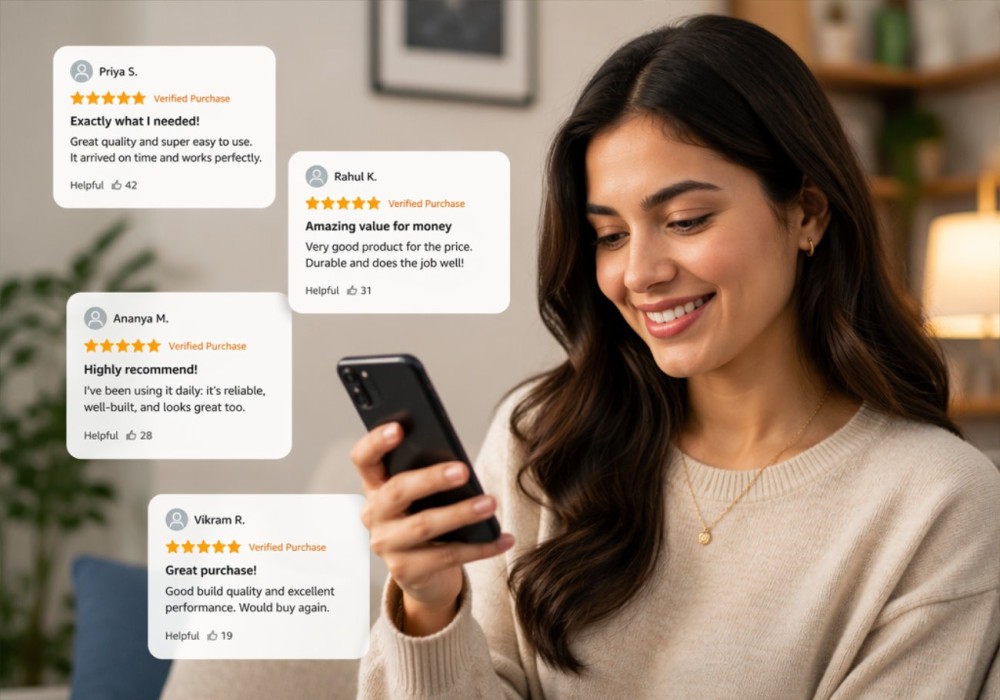
A short five-star review isn't automatically fake, just as a long and detailed review isn't automatically genuine.
Real customers write reviews in very different ways.
Some might write several paragraphs describing their experience, while another perfectly legitimate customer might simply write:
"Great product. Exactly what I needed."
That's why individual reviews should rarely be judged on one characteristic alone.
Instead, look for combinations of unusual behaviour and broader patterns.
Look For Unnatural Review Language
One potential warning sign is language that doesn't sound like a genuine customer describing their experience.
Suspicious reviews may contain:
- Excessive marketing language.
- Repeated product keywords.
- Claims that sound copied from the listing.
- Very generic descriptions.
- Unnaturally enthusiastic wording.
- Similar phrasing across multiple reviews.
For example, a real customer might explain how they use a product in their kitchen and what they liked about it.
A suspicious review may simply repeat several selling points already featured in the product description.
However, wording alone isn't proof of manipulation.
It should be treated as one signal rather than a conclusion.
Watch For Sudden Spikes In Reviews
Review velocity can sometimes reveal unusual activity.
Imagine a product has received two or three reviews each month for the past year.
Suddenly, it receives 100 five-star reviews within a very short period without an obvious increase in sales or promotion.
That could be worth investigating.
There can, of course, be legitimate explanations for sudden review growth, including:
- Prime Day.
- Black Friday.
- Major promotions.
- Viral social media exposure.
- Significant increases in advertising.
- Seasonal demand.
The important thing is whether the increase makes sense compared with the product's apparent sales activity.
Look At The Distribution Of Ratings
Don't only look at the overall star rating.
Look at how those ratings are distributed.
A natural review profile will often contain a mixture of experiences.
Even excellent products can receive:
- Five-star reviews.
- Four-star reviews.
- Three-star reviews.
- Occasional negative feedback.
A product doesn't automatically have fake reviews because nearly all of its customers are positive. Some genuinely excellent products maintain extremely high ratings.
However, an unusual rating distribution combined with other suspicious behaviour may justify a closer look.
Check Whether Reviews Are Repetitive
Another warning sign is a large number of reviews that appear unusually similar.
Look for repeated:
- Phrases.
- Sentence structures.
- Product descriptions.
- Selling points.
- Formatting.
- Claims.
Genuine customers tend to focus on different things.
One buyer might mention packaging, another durability and another ease of use.
When dozens of supposedly independent reviewers appear to describe a product in almost exactly the same way, the pattern may be suspicious.
Be Careful With AI-Generated Reviews
Artificial intelligence has made it easier to generate convincing text at scale.
That means sellers and customers should no longer assume that a well-written review is necessarily genuine.
Potential AI-generated reviews may appear:
- Overly polished.
- Unusually structured.
- Generic despite being lengthy.
- Repetitive in tone.
- Lacking specific personal experience.
Again, none of these characteristics proves that a review was generated by AI.
A genuine customer may simply be a good writer.
The concern comes when large numbers of reviews display remarkably similar characteristics.
Check For Genuine Product Detail
Useful reviews often contain information that suggests the reviewer has actually interacted with the product.
For example, someone reviewing headphones might discuss:
- Comfort after prolonged use.
- Battery life.
- Bluetooth connectivity.
- Sound quality.
- Microphone performance.
Someone reviewing a garden tool might mention how it performed on a particular job or how it felt after extended use.
Specific experience doesn't guarantee authenticity, but detailed observations can provide stronger evidence that the reviewer genuinely understands the product.
Verified Purchase Can Provide Additional Context
Amazon may display a Verified Purchase label on reviews when it can verify that the reviewer purchased the item through Amazon under the applicable conditions.
This can provide customers with additional context when assessing a review.
However, don't use a single label as your entire authenticity test.
The best approach is still to consider the overall quality, relevance and pattern of the reviews you're reading.
Why Fake Reviews Hurt Genuine Amazon Sellers
Fake reviews don't only mislead customers.
They can also damage legitimate businesses.
Imagine you've spent years:
- Developing a quality product.
- Improving your listing.
- Providing excellent customer service.
- Building genuine reviews.
- Following Amazon's policies.
A competitor artificially generating hundreds of positive reviews can create an unfair advantage.
This is precisely why review authenticity matters to both customers and sellers.
Why Sellers Should Never Buy Amazon Reviews
If you're struggling to get Amazon reviews, buying them can look like a tempting shortcut.
It isn't worth the risk.
Sellers should avoid services promising:
- Guaranteed Amazon reviews.
- Five-star review packages.
- Paid reviewers.
- Review exchanges.
- Positive-review guarantees.
- Artificial review growth.
Even if these services claim their methods are "safe", deliberately manipulating reviews can create serious problems for an Amazon business.
The sustainable alternative is to generate genuine feedback from real customers.
How To Get Genuine Amazon Reviews
Getting more genuine reviews doesn't require manipulating customers.
It starts with a product and customer experience worth reviewing.
Sellers should focus on:
- Providing a high-quality product.
- Creating accurate listings.
- Setting realistic customer expectations.
- Providing clear instructions where necessary.
- Using Amazon's official Request a Review process.
- Giving eligible customers an equal opportunity to leave honest feedback.
You cannot control what rating a customer gives you.
And that's exactly how genuine reviews should work.
Ask For Reviews On Amazon The Right Way
Amazon provides sellers with an official Request a Review feature within Seller Central.
Rather than writing your own message asking customers for positive feedback, sellers can use Amazon's standardised review request process for eligible orders.
This keeps the objective simple.
You're not asking for five stars.
You're not filtering customers.
You're not rewarding positive feedback.
You're simply giving an eligible customer the opportunity to share their genuine experience.
For sellers looking for how to get Amazon reviews safely, this should form the foundation of a compliant review strategy.
Why Review Automation Is Better Than Fake Review Shortcuts
The frustrating part of legitimate review growth is that not every customer will leave feedback.
That's normal.
The solution isn't to manufacture reviews.
It's to maximise the number of genuine review opportunities you create.
If you're manually requesting reviews, eligible orders can easily be forgotten. The more orders you process, the harder it becomes to manage review requests consistently.
This is where automation provides a legitimate advantage.
Build Genuine Amazon Reviews With Amzigo
Amzigo's Automated Review Centre helps sellers automate Amazon's official Request a Review process across eligible orders.
Instead of relying on paid reviews, bots, review groups or questionable tactics, Amzigo focuses on something far more sustainable: real customers and genuine feedback.
Amzigo helps sellers:
- Automate Amazon review requests.
- Reduce manual administration.
- Avoid missed eligible orders.
- Build a consistent review request process.
- Keep review generation centred around Amazon's official system.
There are no guaranteed five-star reviews because no legitimate review tool should be able to guarantee them.
The customer decides what rating your product deserves.
Amzigo simply helps make sure you're consistently creating opportunities for genuine customers to share their experiences.
Genuine Reviews Are More Valuable Long Term
Fake reviews may make a listing look stronger temporarily.
Genuine reviews build something much more valuable: trust.
Real customer feedback helps future shoppers understand:
- What your product does well.
- How people actually use it.
- What customers like about it.
- Whether it suits their needs.
- What they should expect after purchasing.
That authenticity is difficult to manufacture and becomes increasingly valuable as your review profile grows.
A sustainable Amazon business should therefore focus on building reviews gradually through genuine sales rather than chasing artificial numbers.
Key Takeaways
There is no foolproof way to identify a fake Amazon review simply by looking at one piece of feedback.
Instead, watch for combinations of suspicious signals such as:
- Sudden unexplained increases in reviews.
- Repetitive wording across multiple reviewers.
- Reviews that simply repeat marketing claims.
- Unusual patterns in rating activity.
- Large numbers of generic or potentially automated reviews.
- Review activity that doesn't appear consistent with normal customer behaviour.
For Amazon sellers, the bigger lesson is simple.
Don't compete with suspicious reviews by trying to manufacture your own.
Build a quality product, provide an excellent customer experience and consistently ask eligible customers for honest feedback using Amazon's official process.
Amzigo helps automate that process so sellers can focus on genuine, compliant review growth rather than shortcuts that could put their Amazon business at risk.